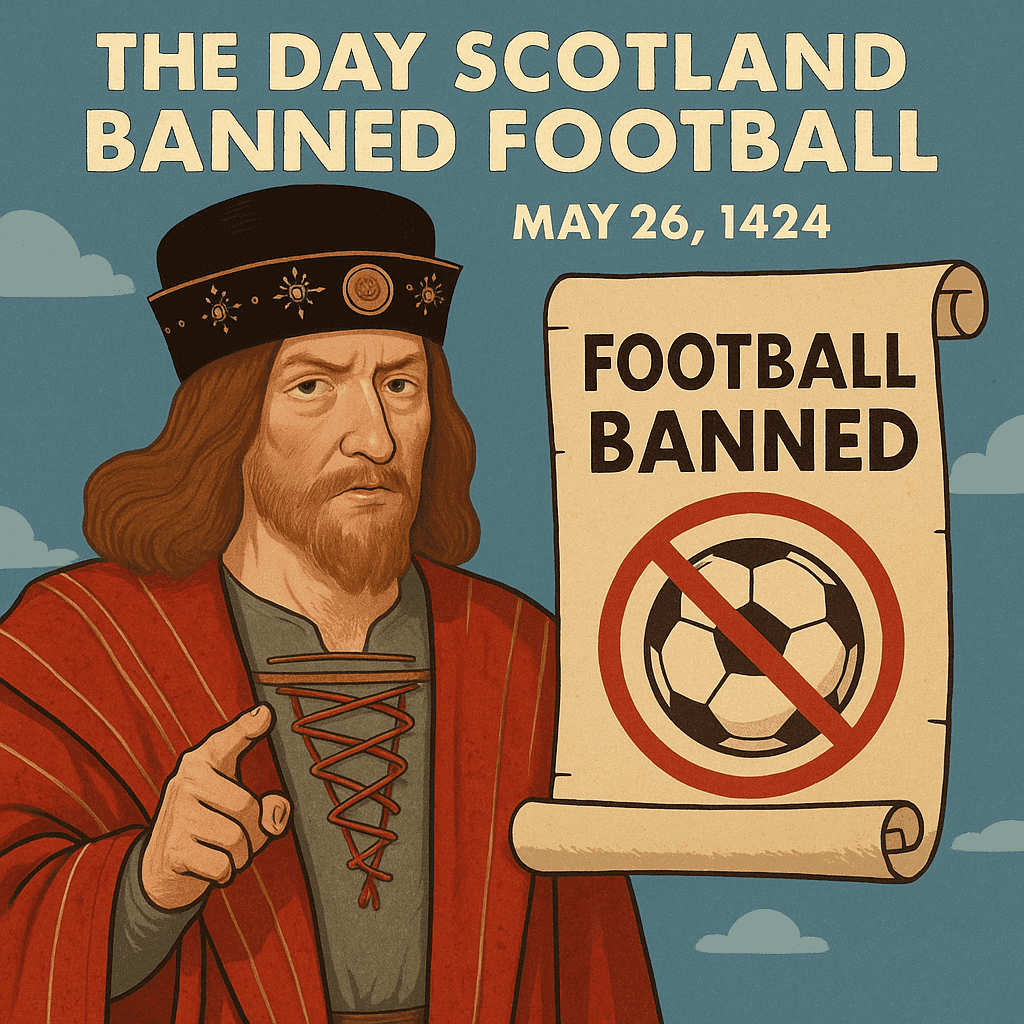
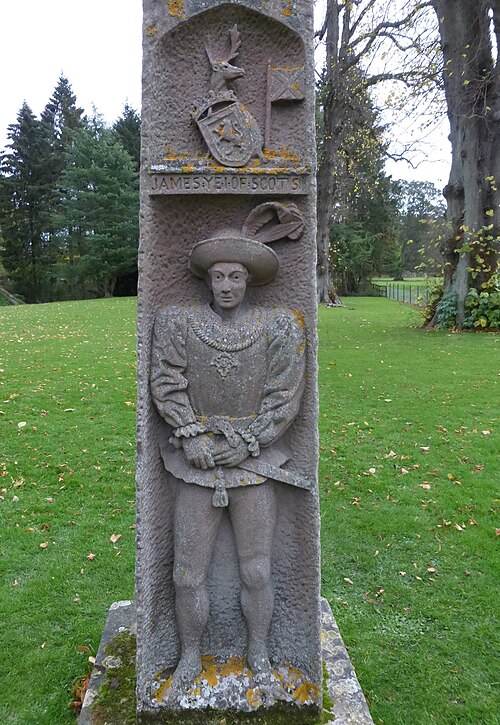
Picture this: It’s May 26, 1424, and King James I of Scotland is about to make one of the most audacious political moves in medieval history.
Fresh from eighteen years of English captivity, he’s returned to find his kingdom soft, his nobles rebellious, and his people more interested in kicking a ball around than defending their homeland. His solution? Ban football entirely—and while he’s at it, systematically destroy the most powerful family in Scotland.
When the Beautiful Game Became the Enemy
The scene unfolded not in Edinburgh, as one might expect, but in Perth, where James convened what would become one of Scotland’s most consequential parliamentary sessions. Among the twenty-seven acts passed that day, one would echo through centuries: the Football Act of 1424, which declared “na man play at the fut ball under the payne of iiij d. to the lorde of the lande.”
Four pence might not sound like much, but in medieval terms, it was enough to make you think twice about your weekend plans.
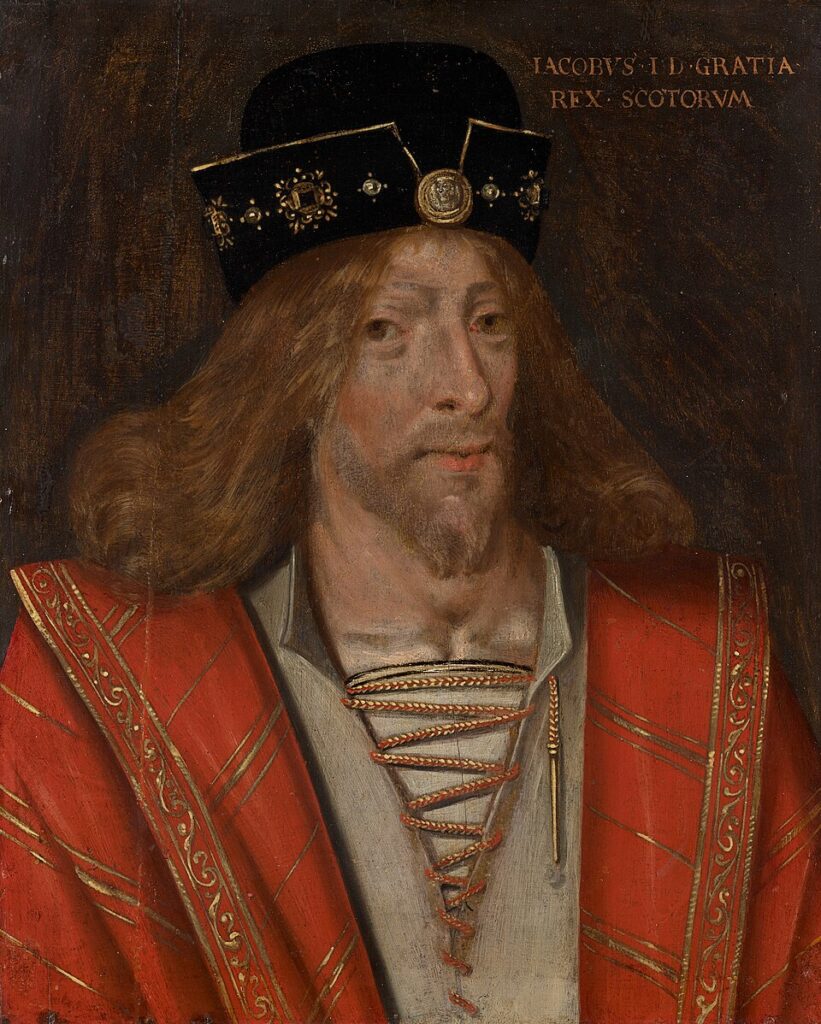
Why did James wage war on football? The answer reveals the brutal pragmatism of medieval kingship. While Scottish men should have been mastering the longbow—the weapon that could pierce French plate armour and send English knights tumbling from their horses—they were instead perfecting their footwork on makeshift pitches. Military training was mandatory for all males over twelve, yet as contemporary sources lamented, “the sports were proving too much of a welcome distraction.”
The king faced a stark reality: a kingdom where “ordinary people preferred to spend their leisure time playing golf and football” rather than preparing for the next English invasion was a kingdom ripe for conquest. In an age when military competence meant the difference between independence and subjugation, recreational preferences could become matters of national survival.
The Stubborn Persistence of Play
James I’s football ban wasn’t a one-off decree that faded into obscurity. It became a recurring nightmare for subsequent monarchs who discovered that legislating against human nature is harder than conquering enemy territory. James II, clearly frustrated by his subjects’ continued ball-kicking tendencies, declared in 1457 that “football and golf be utterly cried down and not used.” His son, James III, tried again in 1471, ordering that “football and golf be discontinued in the future, and butts made up and shot used according to the tenor of the act of parliament.”
The repeated prohibitions tell a story more compelling than any single law: Scottish commoners loved their sports enough to risk royal displeasure, generation after generation. Each renewal of the ban serves as testament to the irrepressible human desire to play, even when kings demand otherwise.
Blood, Betrayal, and the Albany Stewarts
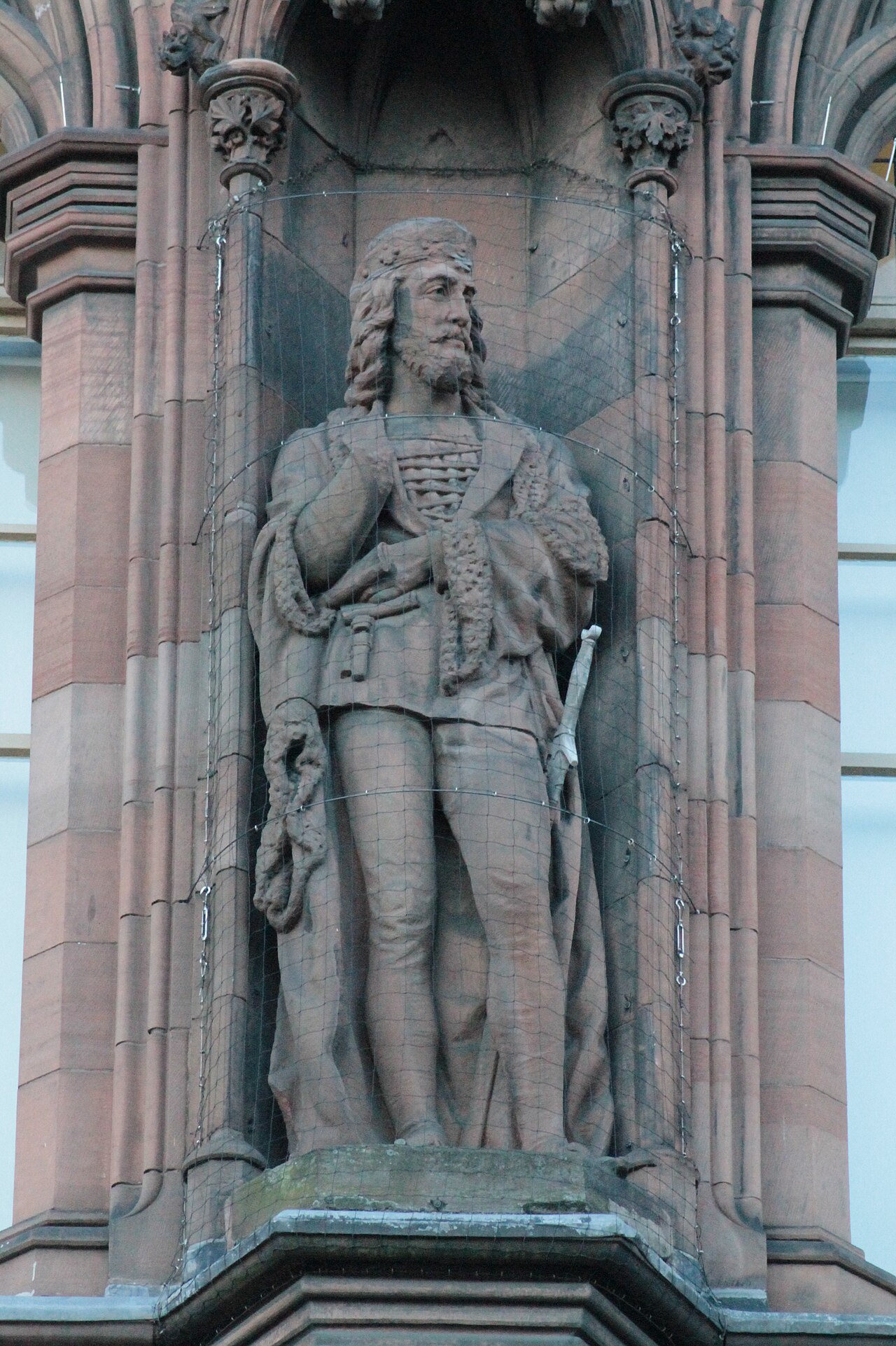
While parliament debated recreational restrictions, James was orchestrating a far deadlier game behind the scenes. The Albany Stewart family—led by Murdoch, Duke of Albany—had effectively ruled Scotland during the king’s captivity, growing rich and powerful while their rightful monarch languished in English dungeons. James hadn’t forgotten, and he certainly hadn’t forgiven.
The king’s campaign began with surgical precision. Walter Stewart found himself arrested on May 13, 1424, and imprisoned on the forbidding Bass Rock. This wasn’t merely about settling old scores—it was about demonstrating that royal authority had returned with a vengeance. The message was clear: the days of the Albany Stewarts’ quasi-royal power were numbered.
The reckoning came in May 1425, when Murdoch Stewart, Duke of Albany, along with his sons Walter and Alexander, and Duncan, Earl of Lennox, faced treason charges at Stirling Castle. The proceedings moved with medieval efficiency: Walter was condemned on May 24, the others on May 25, and all were executed immediately “in front of the castle.” In a matter of days, James had eliminated the most powerful rival dynasty in Scotland and seized “the three forfeited earldoms of Fife, Menteith and Lennox.”
The Parliament That Dared to Defy Kings
What makes the 1424 parliament particularly fascinating is that it reveals a medieval institution far from the rubber-stamp body one might expect. The Scottish Parliament of this era was “often willing to defy the King—it was far from being simply a ‘rubber stamp’ of royal decisions.” Meeting “on average over once a year,” it had evolved into a sophisticated political forum where clergy, nobility, and burgh representatives could challenge royal authority when circumstances demanded.
The fact that parliament supported both the football ban and James’s broader legislative program suggests genuine consensus about Scotland’s precarious position. Yet this cooperation would prove temporary, as future sessions would witness fierce conflicts over taxation and military campaigns. The king who could ban football couldn’t always bend parliament to his will.
Legacy of the Long Game
The 1424 parliament produced legislation that would outlast kingdoms. The Royal Mines Act, declaring that gold and silver mines belonged to the crown, remains the oldest statute still in force in Scotland today. Meanwhile, the Football Act established a pattern of state interference in popular culture that reflected broader European trends toward centralised authority and social control.
But perhaps the most enduring legacy was the demonstration that medieval kingship required more than military prowess or noble blood—it demanded the political skill to reshape society through legal instruments. James I’s systematic approach to eliminating rivals and redirecting popular energy toward state purposes provided a template for royal authority that would influence Scottish governance for generations.
The irony, of course, is that the king who so masterfully eliminated his enemies through legal and political manoeuvring would himself fall victim to violence. In 1437, “his own uncle, Walter, Earl of Atholl and a group of resentful fellow conspirators” assassinated James I, proving that even the most cunning royal strategies couldn’t entirely tame the brutal realities of medieval politics.
The Beautiful Game’s Ultimate Victory
History offers its own verdict on the football ban: it failed spectacularly. Despite repeated royal prohibitions spanning multiple reigns, Scots continued to play football. The sport that medieval kings saw as a threat to national security would eventually become Scotland’s national obsession, producing legendary players and passionate supporters who would make their ancestors’ surreptitious medieval matches look positively tame.
In the end, the Football Act of 1424 stands as a fascinating window into a world where kings believed they could legislate human nature, where recreational choices carried political implications, and where the fate of nations might hang on whether men preferred arrows or goals. It reminds us that even in the ages of absolute monarchy, some forces—like the human desire to play—prove remarkably difficult to control.
The parliament of May 26, 1424, gave us more than historical curiosities. It revealed the eternal tension between authority and freedom, between state security and personal pleasure, between what rulers demand and what people want to do on a sunny afternoon. James I won many battles that day, but in the long game, football scored the ultimate goal.
Sources:
1. The Football Act of 1424 and Context
Scottish Parliament Official Records (not direct to 1424, but context and later acts):
https://www.parliament.scot/about/parliamentary-history
Scottish History Society – The Acts of the Parliaments of Scotland:
https://archive.org/details/actsofparliament01scotuoft (See Volume 1, p. 2 for early acts, but 1424 is not digitised in full plain text here—summary and context are available in secondary sources.)
National Records of Scotland – Parliaments & Conventions:
https://www.nrscotland.gov.uk/research/guides/parliaments-and-conventions-of-estates
2. James I, Albany Stewarts, and Treason Trials
Oxford Dictionary of National Biography (requires subscription, but summary available):
https://www.oxforddnb.com/display/10.1093/ref:odnb/9780198614128.001.0001/odnb-9780198614128-e-15487 (James I of Scotland)
Walter Bower, Scotichronicon (Chronicle of Scotland, translated):
https://www.socantscot.org/research-project/scotichronicon/
(For primary source context, especially regarding parliament and James I’s actions.)
3. Military Training and Sports in Medieval Scotland
BBC Scotland – History of Football in Scotland:
https://www.bbc.co.uk/scotland/sportscotland/asportingnation/article/0012/index.shtml
(General context, not specific to 1424, but discusses the ban on football and archery practice.)
The Scotsman – “Why was football banned in Scotland in the 15th century?”:
https://www.scotsman.com/sport/football/why-was-football-banned-in-scotland-in-the-15th-century-1-4879114
4. General Scottish Medieval History
Undiscovered Scotland – Timeline of Scottish History:
https://www.undiscoveredscotland.co.uk/usfeatures/timeline/index.html
The Scottish History Society – Online Resources:
https://www.scottishhistorysociety.com/resources/
5. Mines and Economic Legislation (Royal Mines Act 1424)
Scottish Legal History – Statutes Still in Force:
https://www.lawscot.org.uk/members/journal/issues/vol-55-issue-4/statutes-still-in-force/
Note:
For the most detailed, original text of the 1424 Parliament, consult the printed volumes of The Acts of the Parliaments of Scotland (Volume 1), which are not fully available in plain text online, but summaries and context are widely cited in secondary sources and the above references.