
TLDR ⓘ TLDR means “Too Long; Didn’t Read” — a short, plain-English summary of the key points.
A quick snapshot of the article, before you read on.
Scotland’s position in global education rankings is closely linked to the reach and influence of its universities, particularly in cities such as Edinburgh where higher education shapes workforce skills, economic resilience and international reputation.
- Scotland ranks second globally for adults with a bachelor’s degree or higher.
- The figure is based on a narrow definition and private research.
- Broader international measures produce different rankings.
- Edinburgh’s universities play a central role in the country’s results.
- The ranking reflects strength, but context matters.
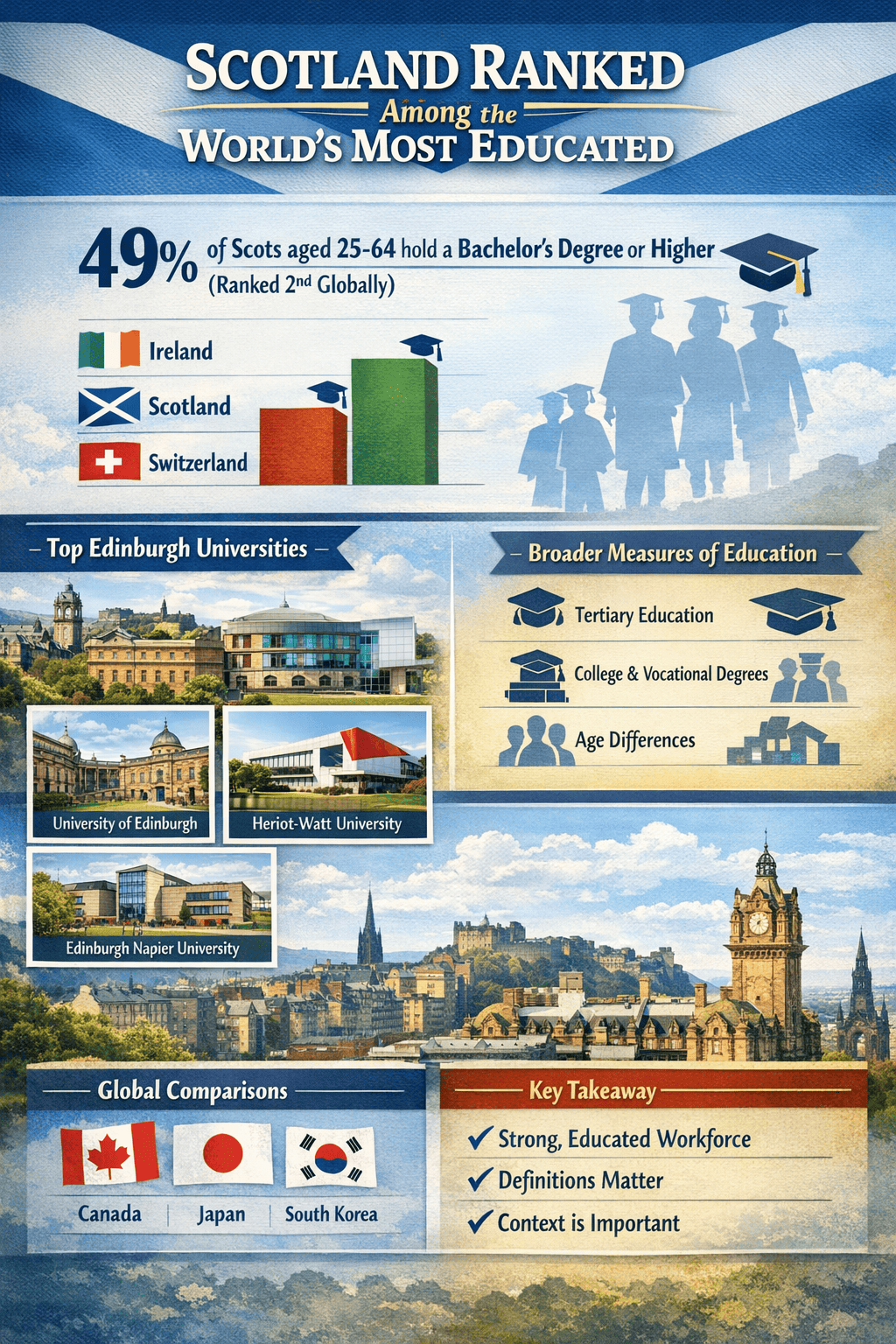
Scotland has once again appeared near the top of a global education ranking, with recent figures placing the country second in the world for the proportion of adults holding a bachelor’s degree or higher.
According to the data, 49 percent of Scots aged 25 to 64 have at least an undergraduate degree. That places Scotland just behind Ireland and ahead of countries including Switzerland, Singapore and England. The statistic has been widely shared online in recent weeks, often presented as evidence of Scotland’s global educational standing.
The figure is striking, but education experts caution that it needs careful interpretation.
Scotland’s strong showing in education rankings is closely tied to the reach and influence of its universities. From long-established institutions to newer, industry-focused campuses, Scottish universities have played a central role in expanding access to higher education over recent decades. This concentration of degree-level learning has helped shape workforce skills, regional economies and international perceptions of higher education in Scotland, particularly in cities such as Edinburgh where academic life and civic identity are deeply connected.
Where the ranking comes from
The ranking is based on private research published in 2025. It measures only one indicator: the share of adults aged 25 to 64 who hold a bachelor’s degree or higher qualification.
Under that definition, Scotland performs exceptionally well. High rates of university participation over several decades, combined with a workforce that retains graduates into mid-career, have pushed the proportion upward.
Edinburgh plays a significant part in this picture. The capital’s concentration of higher education institutions attracts students and professionals from across the UK and overseas, many of whom remain in the city after graduating.
Institutions such as University of Edinburgh, Heriot-Watt University and Edinburgh Napier University underpin a highly educated local population. Graduates feed into sectors including finance, technology, research, healthcare and the creative industries, reinforcing Edinburgh’s reputation as a knowledge-based city.
Why rankings vary
While the statistic itself is accurate, it is not an official international league table. Global organisations such as the OECD use a broader definition known as tertiary education. This includes college diplomas, short-cycle degrees and vocational higher education alongside traditional university degrees.
When those wider qualifications are counted, countries such as Canada, Japan and South Korea often rank higher overall. Scotland and the wider UK continue to perform strongly, but their position shifts depending on what qualifications are included.
Age range also affects results. Younger adults are more likely to hold degrees than older generations, meaning rankings can change significantly depending on the cohort being measured.
What it means for Scotland and Edinburgh
Despite the technical nuances, Scotland’s position near the top of global education comparisons reflects a genuine national strength. A well-qualified population supports productivity, innovation and long-term economic resilience.
For Edinburgh, education remains central to the city’s identity and international profile. Universities, research centres and spin-out companies contribute not only to employment, but also to cultural life, global connections and the city’s ability to attract talent and investment.
The takeaway
Scotland’s high ranking is real, but it represents one way of measuring education rather than a definitive global verdict. Definitions, data sources and age groups all shape the outcome.
The more meaningful story is Scotland’s sustained capacity to educate, attract and retain skilled people. On that broader measure, Edinburgh and the wider country continue to stand out as places where learning and expertise remain deeply embedded in civic and economic life.
Official Definitions and Global Context
- OECD defines tertiary education — the broader category used in international comparisons — as including university degrees and vocational programmes.
- OECD’s Education at a Glance reports show trends in tertiary education attainment across OECD countries.
- Data visualisations from OECD confirm how adult education levels (highest completed level) are measured for ages 25–64.
Scotland and UK Data
- Scottish Census data shows educational qualifications for Scottish residents and that Edinburgh has the highest proportion of degree-level qualifications within Scotland.
- UK Education and Training Statistics include information on higher education enrolment and highest qualification levels.
- Scottish Government attainment reports provide broader data on school leavers and destinations, which can be used to contextualise higher education progression.
Additional Context
- OECD and HEPI coverage explains that tertiary attainment across OECD countries has risen substantially, helping frame global ranking discussions.
- WorldPopulationReview lists countries by tertiary education attainment, useful for comparative graphics (though data years differ).