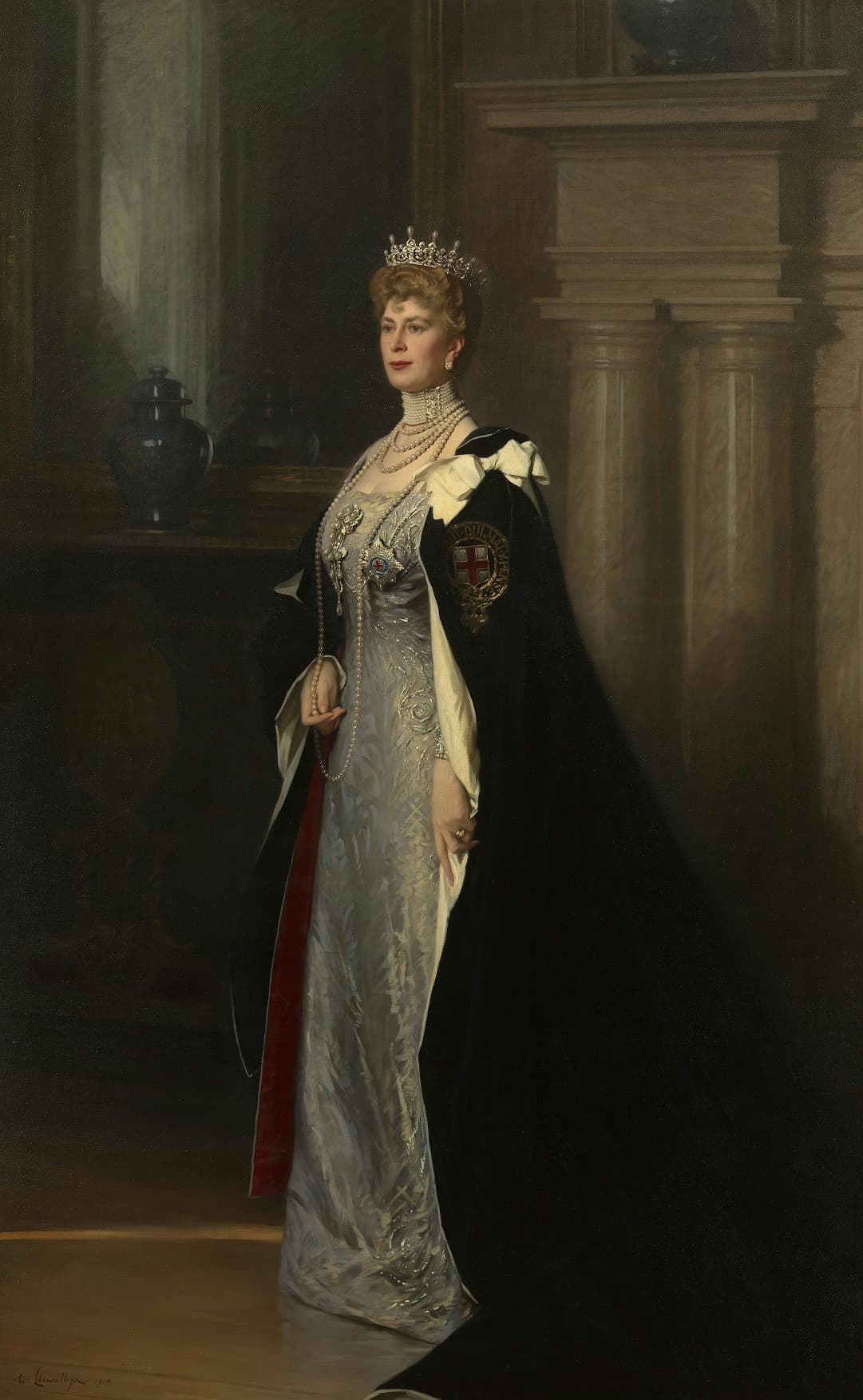
A glamorous portrait of Queen Mary, never previously exhibited, alongside a miniature sleigh crafted from silver and rock crystal, will be among the standout exhibits arriving in Scotland for the first time as part of a major exhibition opening this spring.
The Edwardians: Age of Elegance will delve into the dazzling world of two of Britain’s most stylish royal couples – King Edward VII and Queen Alexandra, and King George V and Queen Mary – exploring their family ties, royal occasions, international travels and passion for art collecting.
The exhibition will open in Edinburgh following a successful run in London and is the first Royal Collection Trust exhibition to explore the Edwardian era. It will bring together more than 150 items including fashion, paintings and books, as well as personal items such as jewellery, photographs and chinaware, more than half of which are on show in Scotland for the first time. Visitors will see works from the Royal Collection by many of the period’s most celebrated names, including Fabergé, Tiffany & Co, and Edward Burne-Jones, and depictions of famous faces including composer Sir Edward Elgar.
‘The Edwardian era was a golden age of glamour and parties, but it was so much more than that; it was a fast-paced period making great advances in technology. Our royal couples wanted to make the most of it all, living lavishly and embracing new trends, before the sobering arrival of war. Throughout, they were collecting art as a way to hold onto tradition and capture the rapidly changing world around them. We hope that visitors to the exhibition will enjoy stepping back in time to this exciting period.’
Curator Kathryn Jones
In 1863, Queen Victoria’s eldest son Albert Edward married Princess Alexandra of Denmark. The marriage of the fashionable young couple – the future King Edward VII and Queen Alexandra – initiated a glamorous new era for the royal family, with Queen Victoria still in mourning and away from public life. Edward and Alexandra established a new, vibrant court filled with opulent balls, society events and contemporary art – a lifestyle continued by their son, the future King George V, and his wife Queen Mary.
Full-length portraits of the two Queens will open the exhibition, showcasing the spectacular fashions of the era. The portraits of Queen Alexandra by François Flameng, and Queen Mary by William Samuel Henry Llewellyn (which has never before been on public display) will be shown alongside marble busts of their husbands, Kings Edward and George. Both couples were fond of Scotland, with Edward having studied at the University of Edinburgh and George and Mary making regular visits and devotedly modernising the Palace of Holyroodhouse to make it once again suitable for royal entertaining.
Displays will evoke the interiors of the royal couples’ private residences, Marlborough House and Sandringham House, where the Edwardian fashion of filling every cabinet and covering every surface small decorative objects or family photographs reigned.
A star object on display for the first time in Scotland is a paperweight shaped like a tiny 10cm-tall sledge with a figure lying on it by Robert Colquhon. Thought to have been Scottish, Colquhon was a goldsmith based in Russia who made small-scale decorative objects from rock crystal and silver of snowy subjects like sleighs and bears on ice floes. Edward and Alexandra collected several of his works – with one of his sleighs appearing in a photograph of Alexandra’s desk in Marlborough House in the 1890s.
Visitors will also learn of the relationships linking the family to the rest of Europe. Fabergé was introduced to the British royal family through Alexandra’s sister Dagmar, who had married Alexander III, Tsar of Russia. The royal patronage caused the popularity of Fabergé to soar in the UK, and on show will be 21 items from the firm, including an ornate picture frame holding a photograph of Princess Louise, Duchess of Fife; a cigarette case famously given to Edward by his official mistress Mrs Keppel; and six miniature figures of the royal couple’s favourite animals on the Sandringham estate.
As enthusiastic patrons of the arts, the Edwardians embraced new artistic movements including Art Nouveau and Arts and Crafts, and the burgeoning medium of photography. Alexandra was particularly taken with the drawings of the Pre-Raphaelite artist, Edward Burne-Jones, whose study for a larger painting inspired by Sleeping Beauty will be on display. A soft-focus photograph of Alexandra by photographer Alice Hughes was typical of her pioneering yet delicate style, and both are on display in Scotland for the first time.
Garden parties formed an essential part of the Edwardian social calendar, with the first taking place at the Palace of Holyroodhouse during the much-anticipated visit of George and Mary in 1911. Danish painter Laurits Tuxen had been introduced to Queen Victoria through her daughter-in-law Alexandra, and his painting of a garden party at Buckingham Palace captures the spirit of the joyous occasion.
Contributions to society were also celebrated through the founding of the Order of Merit in 1902 to recognise prominent figures in cultural, scientific or military life. George commissioned a portrait of each recipient – a tradition that continues to this day – and drawings of Sir Edward Elgar and the physicist Sir J.J. Thomson by Scottish artist William Strang will be on display for the first time in Scotland.
The turn of the century saw great improvements to methods of travel, and the Edwardian royals travelled further than any previous members of the royal family – collecting and receiving gifts as they went. In February 1901, George and Mary set sail for 10 months on HMS Ophir to open the new federal parliament in Melbourne, Australia. To mark the occasion, the ‘Ladies of Adelaide’ gave Mary a richly embroidered silk hanging featuring a eucalyptus tree and local varieties of irises and orchids.
George and Mary visited the Palace of Holyroodhouse in July 1914, only a few weeks before the outbreak of the First World War. The glamour of the Edwardian era was being eclipsed by a serious atmosphere of duty – a sentiment led by the King, as Herbert Arnould Olivier’s study of King George V and Frank O. Salisbury’s painting The Passing of the Unknown Warrior, King George V as Chief Mourner, Whitehall attest.
Collecting had now become a way to honour the many sacrifices made in the Great War; a more restrained and dutiful monarchy had emerged.
The King’s Gallery will continue to offer £1 tickets for visitors receiving Universal Credit and other named benefits. Other concessionary rates are available, including discounted tickets for Young People, half-price entry for children (with under-fives free), and the option to convert standard tickets bought directly from Royal Collection Trust into a 1-Year Pass for unlimited re-entry for 12 months.
The Edwardians: Age of Elegance
The King’s Gallery, Palace of Holyroodhouse, Edinburgh
24 April – 6 December 2026